
When the right lender lets you borrow against what a property is worth, not what you paid for it.
Last updated 7 October 2026
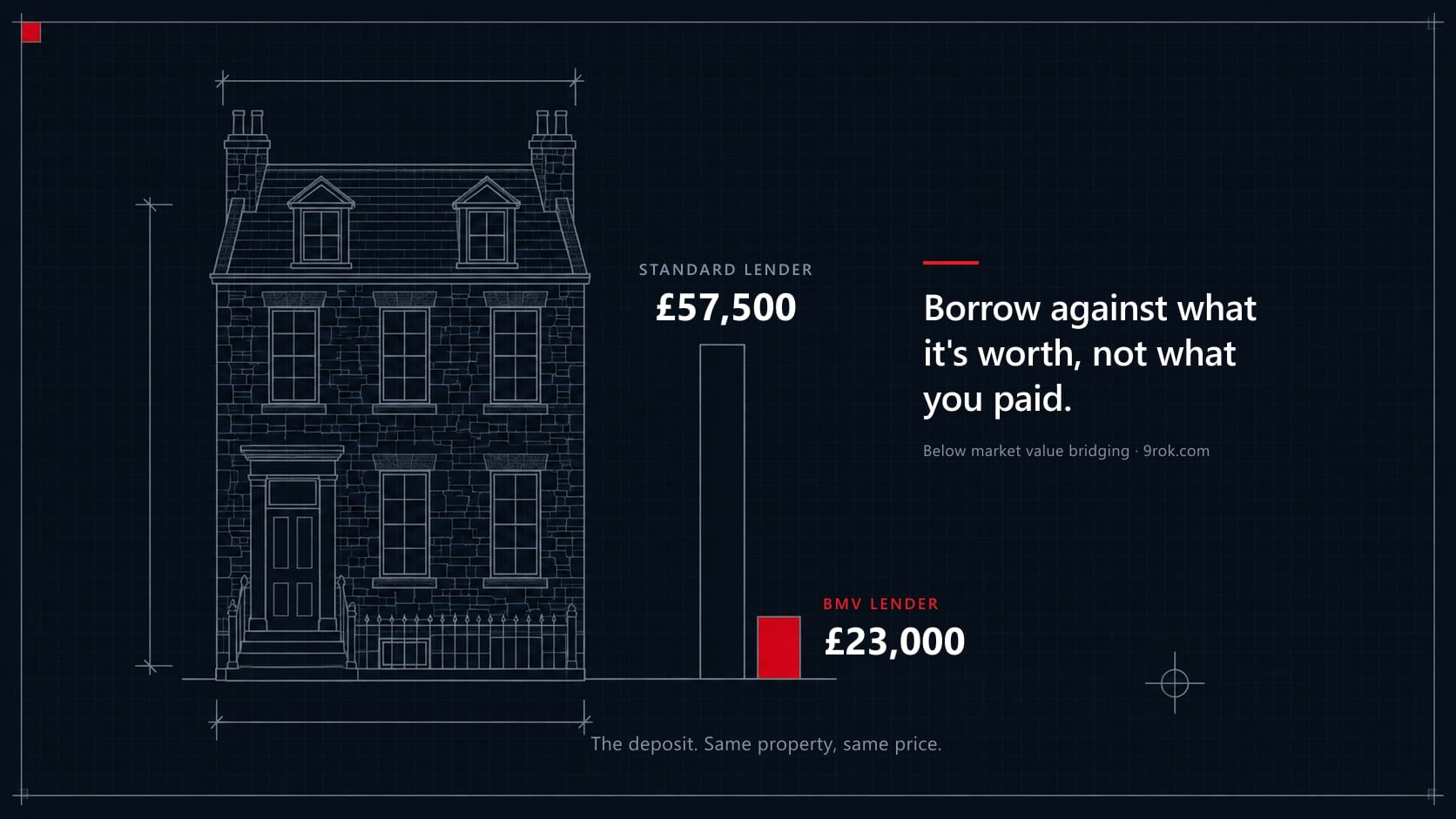
A below market value bridging loan, usually shortened to BMV bridging, is a short-term loan sized against a property’s open market value instead of the discounted price you agreed. Here is the thing that surprises almost everyone the first time they see it: with the right lender, the deposit on a bargain can be a fraction of the normal ask, because the loan is sized against what the property is worth rather than what you are paying for it. Buy well enough and the right lender will fund 90% of your purchase price or more. Most borrowers, and plenty of brokers, do not know this market exists.
Standard bridging maths uses the lower of purchase price and value. Pay £230k for a property worth £300k and a typical lender at 75% loan-to-value lends 75% of £230k, not of £300k. Their logic is blunt: the price you just paid is the best evidence of what the property fetches in a real sale, and if you got it cheap, perhaps the market knows something the valuer does not.
That logic is fair for ordinary purchases. It breaks down when the discount has an honest explanation, and that is the gap a handful of specialist lenders price for.
At the time of writing, specialist bridging lenders will fund genuine below market value purchases at 90% of the purchase price or more on residential investment property, provided the loan stays within roughly 70 to 75% of the open market value. On commercial property the same structure exists with lower ceilings, often referenced to the 180-day value: what the property would fetch with a six-month marketing window rather than a leisurely sale.
Run the numbers on that £300k property bought at £230k:
Same property, same price, less than half the cash in. The discount you negotiated is doing the work a deposit normally does, which is precisely the point: the lender recognises the equity you created by buying well.
These are the structures we are seeing on live cases, as ceilings on the purchase price and on the open market value. The loan is the lower of the two. No lender names, because the list changes and the right one depends on the postcode, the property and the borrower.
| Structure | Ceiling on purchase price | Ceiling on value | What to know |
|---|---|---|---|
| Most common | Up to 90% | 70% to 75% of open market value | Residential investment property. The widest choice of lenders sits here |
| Higher leverage | Up to 95% | Within the lender's normal maximum, up to 80% in places | Priced higher, often with an exit fee |
| Full purchase price | Up to 100% | 70% to 75% of open market value | Qualifying deals only. Needs a discount of 25% to 30% before the full price is funded, and some of these lenders treat Scotland case by case |
| Commercial and semi-commercial | Up to 80% | Around 60% of the 180-day value | Lower ceilings and a more cautious valuation basis. Fewer of these lenders complete in Scotland |
| Portfolio purchases | Up to 90% | 75% of open market value | Bulk discounts on several properties, usually for landlords who already own three or more |
| Purchase price only | Not available | Not available | Many lenders still lend on the lower of price and value, particularly on anything bought within the last six months |
The discount decides which ceiling bites. At 90% of price with a 70% value ceiling you need a discount of about 22% before the full 90% is available. With a 75% ceiling it is about 17%. A smaller discount still helps, it just means the value ceiling sets the loan. To see it on your own figures, use the BMV bridging calculator.
Every one of these lenders leans hard on the word genuine, and their underwriting exists to separate real bargains from manufactured ones. A genuine BMV purchase has an explicable story: a probate sale where the family wants done, a repossession, a motivated seller choosing speed over price, tired stock nobody else would take on, an off-market deal closed in days. An independent valuation has to stand behind the market value figure, and in Scotland the valuer’s comparable evidence matters more than the seller’s optimism.
What fails the test: discounts created on paper through back-to-back contracts, vendor gifted deposits, or related-party sales at friendly prices. That territory is not clever structuring; it is what lender fraud checks and solicitors’ certificates exist to catch, and an application built on it dies badly.
The exit is where BMV purchases get properly interesting. Buy at £230k, spend modestly, and refinance later against the full open market value: done well, the refinance repays the bridge and returns most of your cash, leaving a financed property and your capital free for the next one. Lenders will want a sensible seasoning story and honest figures, but this is the legitimate version of the recycling strategy the property courses sell badly.
Illustrative, not a completed 9ROK deal. Round numbers, no names, and an illustrative case. Two flats in one block in a Highland town, sold by an estate that wanted certainty over the last pound, go to a closing date. The agreed price is £240,000. An independent valuation puts the open market value at £320,000, supported by comparable sales in the same street.
Most lenders measure the value ceiling on the balance including rolled-up interest, which reaches about £233,000 here. Against a 70% ceiling (£224,000) the day-one loan would be trimmed, or the interest would need to be paid monthly.
The figures are illustrative and every lender’s ceilings move, but the mechanism is exactly this: the discount you negotiated does the work a deposit normally does. Check the tax on our LBTT calculator and cost the bridge on the bridging calculator before you bid, or run your own numbers on the BMV bridging calculator, which puts both lenders side by side with the tax included. If the plan is to let the flats rather than sell them, the bridge to let calculator runs the bridge, the works and the refinance in one go, and our page on bridge to let finance covers the refinance tests.
Scotland manufactures genuine discounts more reliably than most markets: closing dates where only one serious bidder shows up, auction lots on tight timelines, estates and rural stock where sellers value certainty over the last pound. Bridging that completes in two to three weeks is what lets you be that certain buyer, and our bridging finance page covers how the short-term market works here, including which lenders genuinely operate north of the border. Cost the bridge itself on the bridging calculator, and if you are new to missives and closing dates, start with how Scottish property finance actually works.
One honest caveat for our home patch: on island and remote rural stock, the valuation evidence carries the deal. A genuine discount on a Tobermory property still needs a valuer who can point at comparables, and lender appetite thins as postcodes get more remote. That is a lender selection problem, and solvable, but build the case before you bid, not after.
If you are buying at a genuine discount, do not accept deposit arithmetic built for full-price buyers. A small, real market exists that will fund most of your purchase price because you bought well, and the difference is tens of thousands of pounds of cash kept in your business. The criteria move constantly, so treat the snapshot above as a dated guide. We check live appetite on every case before quoting anything.
A short-term loan, usually 3 to 18 months, used to buy a property for less than it is worth, where the lender sizes the loan against the open market value instead of the lower purchase price. It is usually shortened to BMV bridging. The result is a smaller deposit than a standard bridge on the same purchase.
Any real discount can help, but the size decides how much. Where the value ceiling is 70% and a standard lender would lend 75% of price, BMV terms only pull ahead once the discount passes about 7%. To be funded at a full 90% of price you need about 22% off against a 70% value ceiling, or about 17% against a 75% ceiling.
We arrange property finance from £75,000. On a BMV purchase that usually means a purchase price of around £84,000 or more.
A small number of specialist bridging lenders do, on genuine discounts, typically advancing up to 90% of the purchase price provided the loan stays inside a ceiling of around 70 to 75% of open market value (lower on commercial). Most lenders still use the lower of price and value, so lender selection is the whole game.
A real discount with an explicable reason: probate sales, repossessions, motivated sellers, deteriorated stock, off-market deals done quickly. An independent valuation has to support the market value figure. Discounts engineered through back-to-back contracts or vendor gifting are exactly what lenders' fraud checks exist to catch.
Almost never in practice. Even where the arithmetic would allow it, lenders want you to have money in the deal, and you still need fees, LBTT and works funding. Treat BMV lending as a way to shrink the deposit substantially, not delete it.
Yes, and Scotland produces exactly the situations that create genuine discounts: closing dates with few bidders, auction lots, estates selling for speed. The caveat is that the lender must genuinely complete in Scotland and the valuation evidence for rural and island stock needs to be strong.
Two to three weeks is realistic in Scotland. Faster is possible on simple cases. It takes a clean title, a valuer who can get to the property and a solicitor who works Scottish conveyancing daily; indicative terms usually come back in 24 to 48 hours. Island and remote rural properties take longer because the valuation itself takes longer to arrange.
On the price you actually pay. Buying at £240,000 means LBTT and any Additional Dwelling Supplement are calculated on £240,000, whatever the valuation says. It is one of the few places where buying well reduces a cost rather than the lender ignoring it.
Bought well, or about to? Send the price, the value and the plan. One working day to an honest view on whether the discount is fundable.